
When most people realize they have mold in their home they, naturally, want to “remove” it. So, why do professionals use the term “mold remediation” when we just want to get rid of our mold problem? Well, the difference between mold removal and mold remediation is in the process involved in eliminating mold. What’s important is to get rid of mold by dealing successfully with its root cause so it won’t easily return to your home or workplace. According to statistics, about 70% of homes have mold issues and about 28% of people are genetically predisposed to mold-related health problems. Consequently, in order to effectively remove mold from your home, it may be necessary to apply a thorough mold remediation process instead of just mold removal.
Mold remediation involves all the processes needed to eliminate mold from your home or business. It can include:
The Environmental Protection Agency (EPA) recommends that any moldy area over 10 square feet should be handled by a professional mold removal contractor or mold remediation service. However, it’s not always the case that you will be able to see the mold in your home since it tends to grow in moist, dark conditions, so it can be hidden from your view. You’ll often find mold in basements, attics, or behind drywall, stucco, and siding. Consequently, if you notice a musty odor, you should inform a mold remediation company to conduct a mold inspection and take the necessary actions to remove any mold infestations. Likewise, if you and/or members of your household experience allergy symptoms, no matter what season it may be, or you start getting headaches/dizziness when you enter your home, these may be indications that you have mold issues.
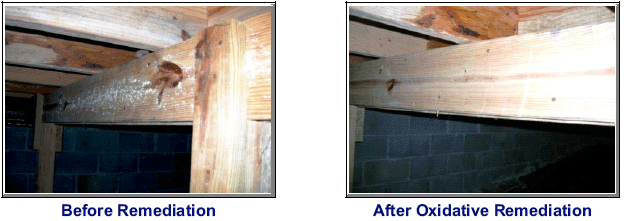
As you might imagine, not all mold remediation methods, solutions, and services are the same, and effectiveness, safety and environmental impacts differ widely from one to another. Most mold remediation methods treat mold as a physical substance versus a biological contaminate and have a negative environmental impact. At Biotek Environmental, Inc., we use Oxidative mold remediation. This remediation process is environmentally safe and designed specifically to address the unique challenges associated with bio-contamination.
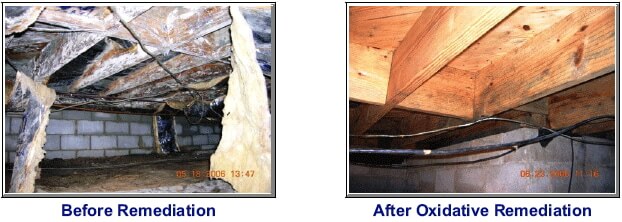
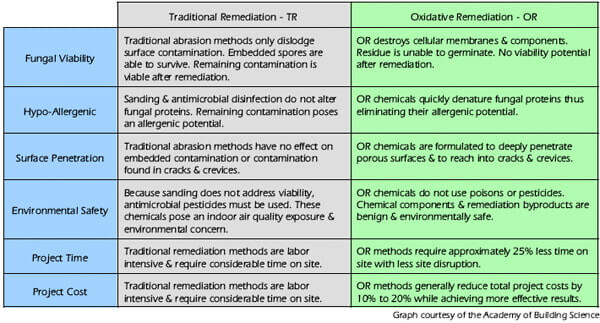
An important fact is that all mold is classified as an irritant capable of creating an allergic reaction in those who are susceptible to its exposure. Oxidative remediation is not only more effective against bio-contamination than traditional methods but is also environmentally safe because the chemical byproducts generated during oxidation quickly break down into elemental oxygen and water. The process does not use chlorine, pesticides, poisons, heavy metals, or other environmentally dangerous chemicals, and there are no dangerous residues remaining after remediation. Because the chemistry is applied in a liquid form under pressure, it can penetrate deeply into porous surfaces, cracks, and crevices where other methods cannot reach, and the end result is the most effective level of biologic decontamination.
No, mold grows much like a mushroom. It produces a root called a hyphal projection that penetrates into porous surfaces. The mold colony uses this root for attachment and as a transport system for absorbing nutrients.
While sanding, brushing, or abrasion may remove the bulk of visible contamination, these techniques cannot reach microscopic subsurface growth. In fact, during the abrasion process, spores and fungal fragments can be driven deeper into the surface. In addition, surface abrasion aerosolizes contamination, potentially spreading contamination.
Any form of surface abrasion drives contamination deeper into surfaces and causes the release of massive levels of airborne contamination. Further, some techniques utilize soda as a blasting media which simply dislodges the surface fungal growth into a fine powder that cannot be HEPA vacuumed. In addition, soda is a caustic agent. As with other abrasive protocols, while surfaces may look clean, viable microscopic spores remain.
The US Department of Labor, OSHA, and the Directorate of Science, Technology and Medicine has issued a safety bulletin warning against the use of biocides and chlorine for mold remediation. Not only are some of these chemicals potentially dangerous, they are only effective on hard nonporous surfaces and even then only on actively growing microorganisms. Dormant spores hiding in porous surfaces are unaffected by these chemicals.
No, biocides, poisons, heavy metals, disinfectants have no effect on fungal proteins. Any fungal proteins that survive sanding, vacuuming, and disinfection remain a potential allergenic contaminate. Proteins must be denatured (digested) in order to be converted from hyper-allergenic to hypo-allergenic components. The only process proven to digest fungal proteins is oxidative chemical decontamination.
Product Description – OSC-500 is an advanced stabilized oxidizing surface cleaner designed for mold remediation professionals. While there are other oxidizing cleaners on the market, our proprietary blend of cleaners and powerful surfactants provides superior surface cleaning properties. OSC-500 is a professional grade remediation product designed to replace caustic sodium hypochlorite formulas. Unlike these formulations, OSC-500 does not pose an exposure hazard, it is not reactive with metals, will not damage surfaces, and leaves no residue.
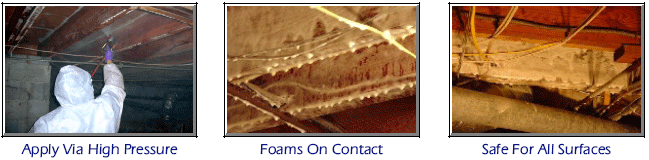
OSC-500 cleans as it oxidizes mold growth and surface stains. As the product comes in contact with organic contamination, it quickly denatures proteins, lipids, and carbohydrates common among all microorganisms. The characteristic foaming action indicates the presence of these proteins and lifts contaminates away from surfaces, while destroying mold, mildew, and algae.
OSC-500 removes fungal spores and hyphae on contact. It can be used on: wood, siding, drywall, walls, canvas, fiberglass, vinyl, plastic, patio furniture, shower stalls, toilet areas, counters, cabinets, and other water safe surfaces. Oxidative Remediation is an environmentally safe process that addressed both fungal viability and allergenicity. It begins working on contact and continues to attack fungal proteins for over 15 minutes. The surfactant formulation ensures deep penetration into cracks, crevices, and porous surfaces. Fungal contamination cannot hide.
OSC-500 is an effective cleaner on wood, brick, concrete, siding, roofing materials, fiberglass, gelcoat, vinyl, plastic, bathroom surfaces, and outdoor furniture.
OSC-500 Highlights:
OSC-500 is a surface cleaner and not bleach. Some deep-set organic stains on wood surfaces may not be completely eliminated. This is not an indication of active mold growth or dormant spores. To ensure maximum protection against future mold growth and to protect surfaces from microbial deterioration, apply Biostat-Pro™. Biostat-Pro is an EPA registered biostatic mold inhibitor designed specifically for the remediation industry.
For more information on Oxidative Mold Remediation procedures and effectiveness, please contact one of our mold remediation professionals at 866-630-7340.