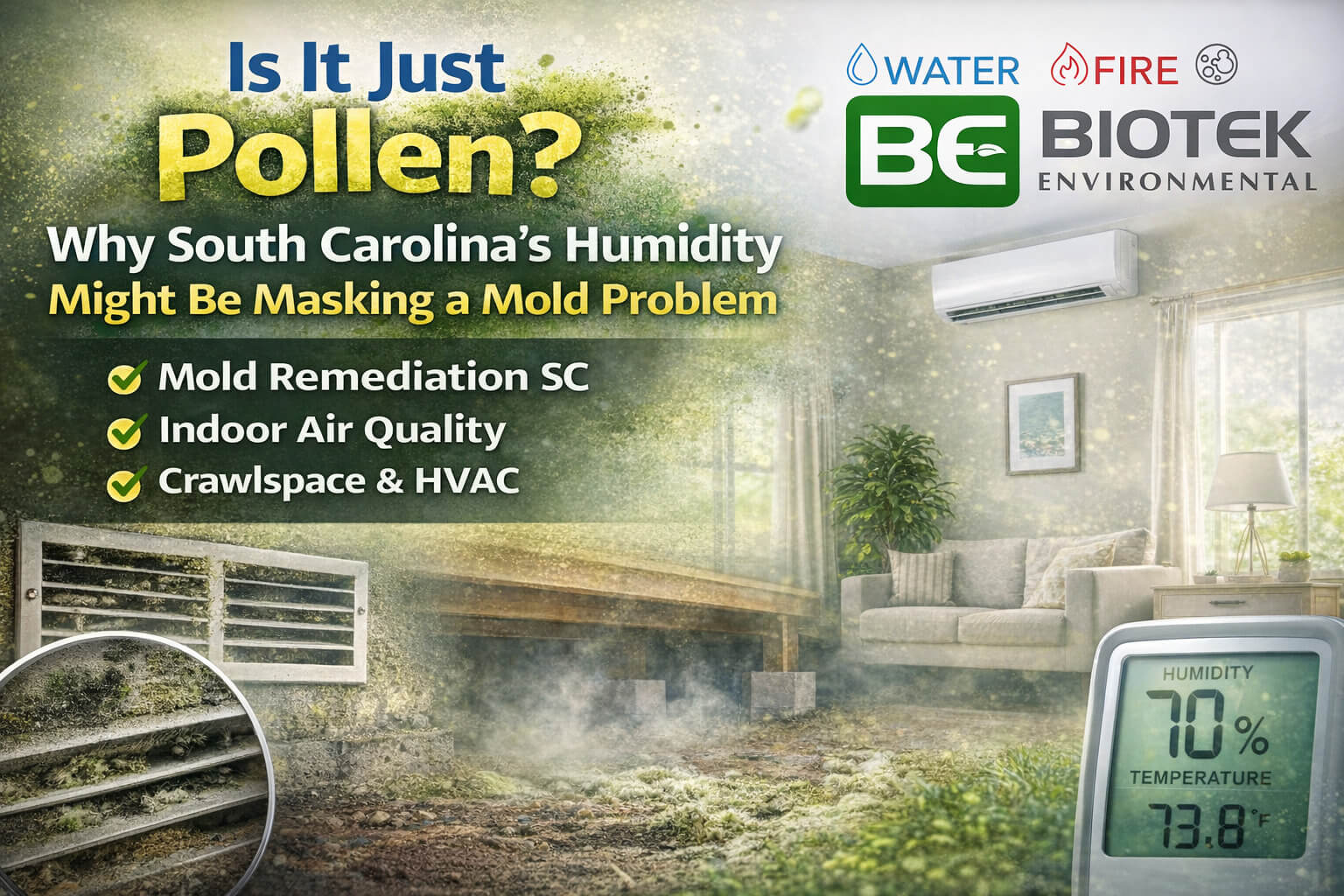
Is It Just Pollen? Why South Carolina’s Humidity
Might Be Masking a Mold Problem
Many South Carolinians blame pollen for their year-round suffering, but your home’s humidity may be hiding a far bigger trigger growing silently in your crawlspace and HVAC system.
Every spring, South Carolinians know the signs. Cars coated in a fluorescent yellow film, eyes itching before you even step outside, and that familiar sneeze that announces oak season has arrived. But here’s the question we ask hundreds of homeowners every year: Why are you still suffering in July?
At BioTek Environmental Inc., we’ve spent nearly two decades investigating the air quality inside Southern homes. What we find, time and again, is that for a significant number of allergy sufferers, pollen is only part of the problem. The deeper, more persistent culprit is quietly growing in your crawlspace, your HVAC ducts, and behind your baseboards and it’s called mold.
We’ve written this article for anyone who has ever stood in a pharmacy aisle loading up on antihistamines, thinking, “There has to be a better answer.” There is. And it starts with understanding your home.

You’ve Tried Everything — So Why Do You Still Feel Awful?
Let’s talk about your daily reality first, because we want you to know: you are not imagining it. These are the experiences we hear from South Carolina residents week after week.
The “Never-Ending Cold”
Pollen season wraps up, the tree blooms fade, yet your congestion, sneezing, and post-nasal drip drag on for months. Your doctor says your bloodwork is fine. But your body is fighting something, constantly.
Indoor Flare-Ups
You feel noticeably worse the moment the AC kicks on, or after a rainy weekend spent at home. Something about being inside your own house makes your eyes water and your chest tighten. That’s not a coincidence.
Brain Fog & Exhaustion
It’s not just sniffles. It’s a persistent, heavy fatigue; the kind that makes it hard to focus at work. A relentlessly activated immune system drains your energy reserves day after day.
The Financial Drain
Months of over-the-counter antihistamines, decongestants, and copays add up quickly, yet you never truly feel well. You’re masking symptoms, not solving the underlying environmental problem.
If any of these scenarios sound familiar, it’s time to look beyond the pollen count and into the air quality inside your home.
The Science: How Mold Amplifies Your Allergy Symptoms
To understand why mold makes seasonal allergies so much worse, you first need to grasp a concept immunologists call the “Total Body Burden.”Think of your immune system as a bucket. Every allergen it encounters, for example, pollen, pet dander, dust mites, and mold spores, fills that bucket a little more. Once it overflows, symptoms become severe and relentless.
The Primed Immune System
During oak or pine season, your immune system is already on high alert. When mold spores from your crawlspace then enter the picture, your body overreacts far more violently than it would to either trigger alone.
The Humidity Sweet Spot
Indoor humidity levels above 60%, which is extremely common in South Carolina homes, create the ideal environment for mold colonies to thrive in crawlspaces, coils, and ductwork year-round.
The Cross-Reaction
Some mold species produce proteins structurally similar to certain tree and grass pollens. Your immune system, unable to distinguish between them, mounts a doubled allergic response to both simultaneously.
This combination of a primed immune system, sky-high indoor spore counts, and cross-reactive proteins, explains why so many South Carolina residents feel like they’re suffering from a “super allergy” that no antihistamine can fully touch. The medication is only addressing half of the equation.
Why the South is Different: Our Climate, Our Challenge
Living in South Carolina means we’re no strangers to humidity. Our warm, wet climate creates conditions that are genuinely unique and uniquely challenging for indoor air quality. Here’s what we see in the field every day.
The Crawlspace Problem
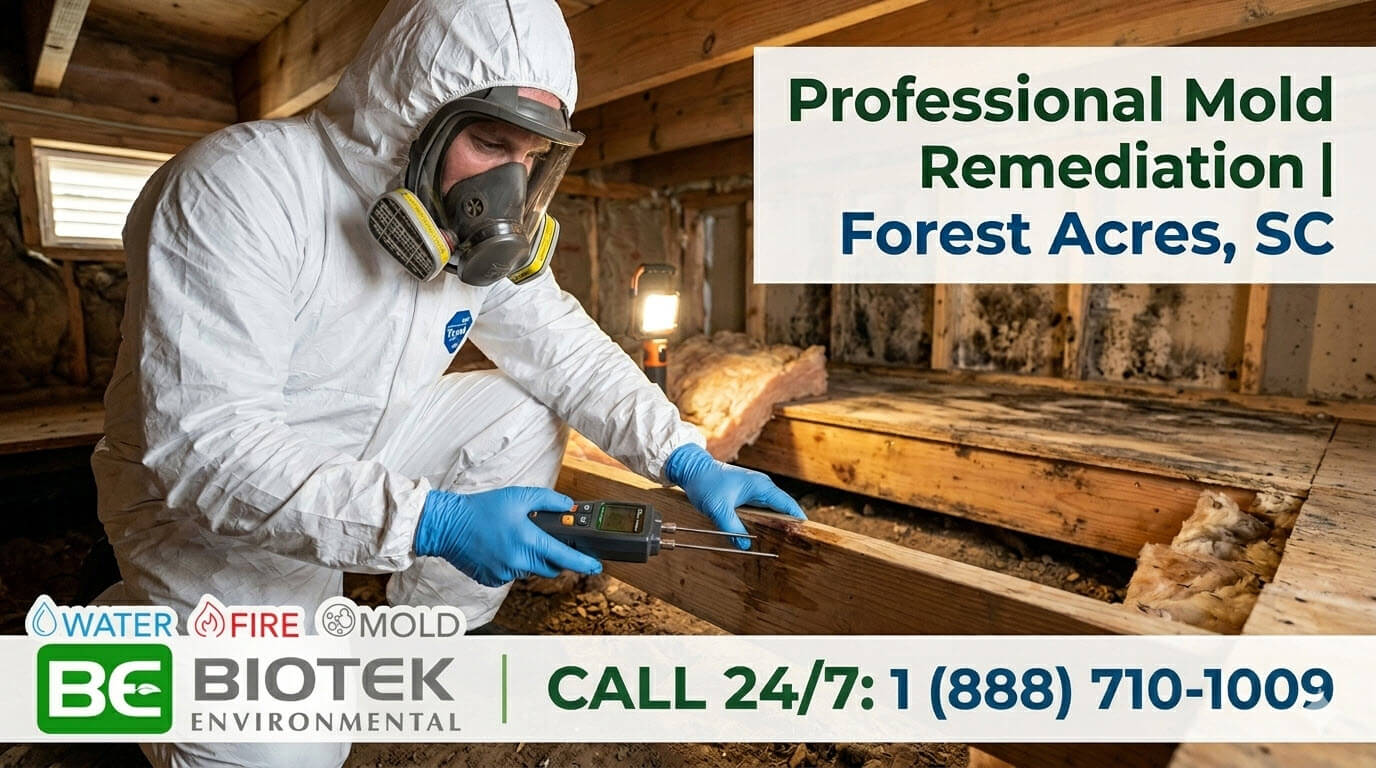
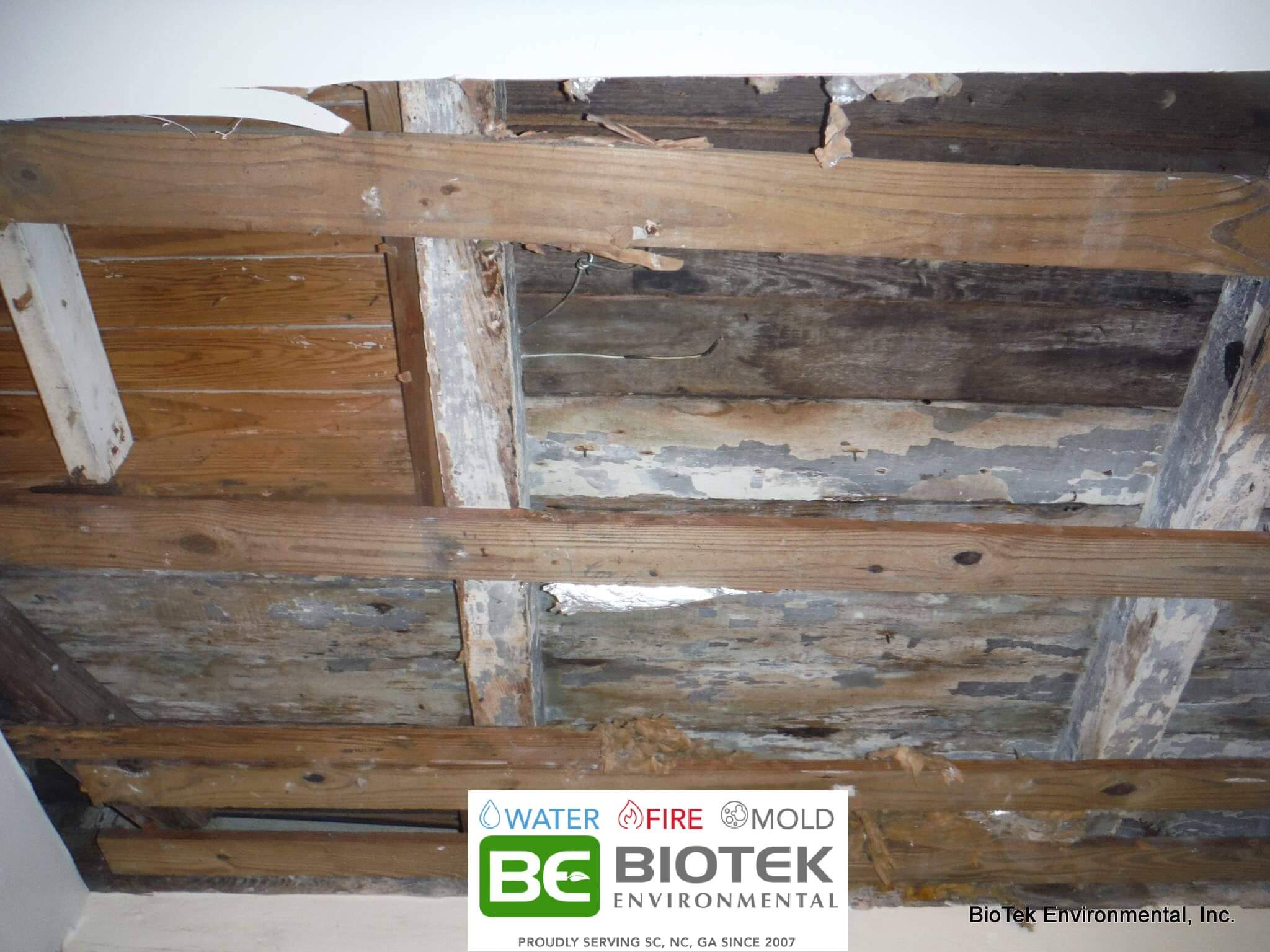
The traditional Southern raised-foundation crawlspace is an architectural marvel of mold cultivation. When warm, moisture-laden summer air enters an open-vented crawlspace, it meets cool soil and cool structural wood and condenses. That trapped moisture soaks into floor joists, subfloor sheathing, and insulation. Left unchecked for even a few weeks, fungal colonies take hold. We frequently find crawlspaces where mold coverage spans entire bays of joists, completely invisible to the homeowner above.

Research on air movement within homes consistently shows that a significant portion of the air circulating in your living space originates from your crawlspace or basement. This is a phenomenon known as the “stack effect.” Mold spores growing beneath your floors don’t stay there; they migrate upward into the spaces where you sleep, eat, and breathe.
The AC Factor
South Carolina’s brutal summers mean our air conditioning systems run for months on end. HVAC coils and drain pans accumulate condensation throughout the cooling season. Without regular professional maintenance, mold colonies establish themselves on these wet surfaces and inside the ductwork downstream. When you switch the system on for the first time in late spring, you may be blasting a concentrated cloud of spores into every room of your house. The timing aligns almost perfectly with peak pollen season, and as a result, doubling your exposure at the worst possible moment.
Summer Thunderstorms & Flash Moisture
Our summer storm patterns can drop inches of rain in under an hour. When that water finds its way under doors, through foundation cracks, or behind poorly sealed windows and siding, it saturates wall cavities and flooring materials. Because these areas are dark, poorly ventilated, and warm, mold can become established within 24 to 48 hours of a moisture event. By the time a musty smell appears, a colony may already be well-developed behind your drywall.
The Invisible Signs: Does Your Home Have a Mold Problem?
Mold is rarely obvious. You won’t always see a black patch spreading across a wall. More often, the signs are subtle and easily dismissed as something else. Here’s what to pay attention to:
- Musty, earthy odors that emerge when humidity rises — If your home smells distinctly different after rain or in hot weather, biological growth is likely the cause.
- Dark “dust” accumulating on AC vents and registers — What looks like ordinary dust buildup is often a mixture of mold spores and particulate matter being distributed by your HVAC system.
- Symptoms that noticeably improve when you leave home — If you feel better on vacation, at the office, or even after a weekend staying with family, the problem is almost certainly environmental and specific to your house.
- Visible discoloration on walls near windows, under sinks, or around HVAC components — Any persistent staining in areas with past moisture exposure warrants professional evaluation.
- Family members with unexplained respiratory symptoms — When multiple people in a household experience similar symptoms without a shared illness, shared air quality is often the common denominator.
One of the most telling indicators we discuss with homeowners is this: Do your allergy symptoms ease dramatically when you leave the house for a week? If so, your home environment, not outdoor pollen, is the primary driver of your suffering. This simple observation has led many of our clients to finally find relief after years of ineffective allergy treatments.
Your Path to Relief: Actionable Steps You Can Take
The goal here is not to alarm you. We want to empower you! The good news is that mold-related indoor air quality problems are highly treatable. Here’s a practical framework for reclaiming your home’s air.
Monitor and Control Indoor Humidity
Purchase an inexpensive digital hygrometer and place it on each floor of your home. Your target range is 30–50% relative humidity. If readings consistently exceed this, a whole-home dehumidifier, particularly one installed in the crawlspace, can be transformative. This single intervention often produces the most dramatic and rapid improvement in symptoms.
Upgrade Your Air Filtration
Standard HVAC filters are designed to protect equipment, not to clean your air. HEPA-rated air purifiers placed in sleeping areas and common rooms can capture mold spores before they are inhaled. For whole-home solutions, ask your HVAC technician about higher-MERV rated filters, but confirm your system can handle the increased airflow restriction first.
Schedule Annual HVAC Maintenance
Before pollen season begins and again before cooling season starts, have your coils cleaned, drain pans inspected, and ductwork checked for condensation or biological growth. This one maintenance habit can significantly reduce what your system distributes into your living spaces throughout the year.
Seek a Professional Mold Assessment — Not a DIY Fix
A bottle of bleach and a sponge will address the surface staining you can see, but it will not resolve the root cause, which is almost always a moisture problem. In Southern homes with crawlspaces, that moisture source may require encapsulation, vapor barrier installation, or foundation drainage work. Professional assessment identifies not just where mold is, but why it is there and that’s the most reliable way to prevent it from returning.
You Don’t Have to Just “Live With” Your Allergies
Here in South Carolina, we accept a lot as part of life, for example, the heat, the humidity, and the inevitable pollen haze, every spring. But suffering through persistent allergy symptoms that never truly resolve? That’s not something you have to accept.
The relationship between outdoor pollen and indoor mold is well-documented and deeply interconnected. When you address only one side of that equation, either taking medication for pollen or occasionally spraying bleach on visible spots, you’re fighting with one hand tied behind your back. Real, lasting relief requires understanding the full picture of your indoor environment.
At BioTek Environmental Inc., we don’t just identify mold, we trace it to its source, remediate it correctly, and provide you with a clear plan to prevent recurrence. Our team has been doing this work in South Carolina, North Carolina, and Georgia since 2007, and we understand the specific pressures that our Southern climate places on homes and the people who live in them.

A healthy home is the foundation of a healthy respiratory system. Let us help you build that foundation.
BioTek Environmental: Your Award-Winning Partner
Since 2007, BioTek Environmental Inc. has been a trusted leader in the restoration industry across South Carolina, North Carolina, and Georgia. Our commitment to excellence has earned us an A+ rating with the Better Business Bureau and the prestigious “Best of South Carolina” award for both 2024 and 2025 – we have also been nominated for 2026.

Award-Winning Service
Recognized as “Best of South Carolina” 2024 & 2025, and carrying an A+ BBB rating — your assurance of quality and integrity on every project.
24/7 Emergency Response
Mold and water damage don’t wait for business hours. We offer around-the-clock emergency services and are typically on-site within a few hours of your call.
30-Year Warranty
Every project we undertake is backed by the most comprehensive 30-year warranties in the industry, providing you with a permanent peace of mind long after the work is done.
Serving Since 2007
Nearly two decades of hands-on experience in the Southern climate means we understand the specific mold and moisture challenges your home faces.
We understand the stress and health concerns that come with mold and water damage. That is why our team is always ready, day or night, to respond quickly, remediate thoroughly, and restore your home’s air quality so you and your family can breathe easy again.
Frequently Asked Questions
These are the questions we hear most often from South Carolina homeowners dealing with mold and allergy issues.